
Luxury Fragrance Production Trade-Offs: A Travel Retail Buyer's Checklist
A travel retail listing is a deadline with a shelf attached, and it forces luxury production decisions to be made in a fixed order rather than a comfortable one. The trade-offs that decide the outcome are rarely about the scent itself; they sit in bottle weight, decoration, fill formats, testing scope and how many exclusive SKUs one launch can carry. Buyers who map those trade-offs before the deposit keep control of both cost and calendar, while buyers who discover them during sampling usually pay for the discovery twice. What follows is the checklist version, written for a launch that will be judged by a passenger in about four seconds.
Key takeaways
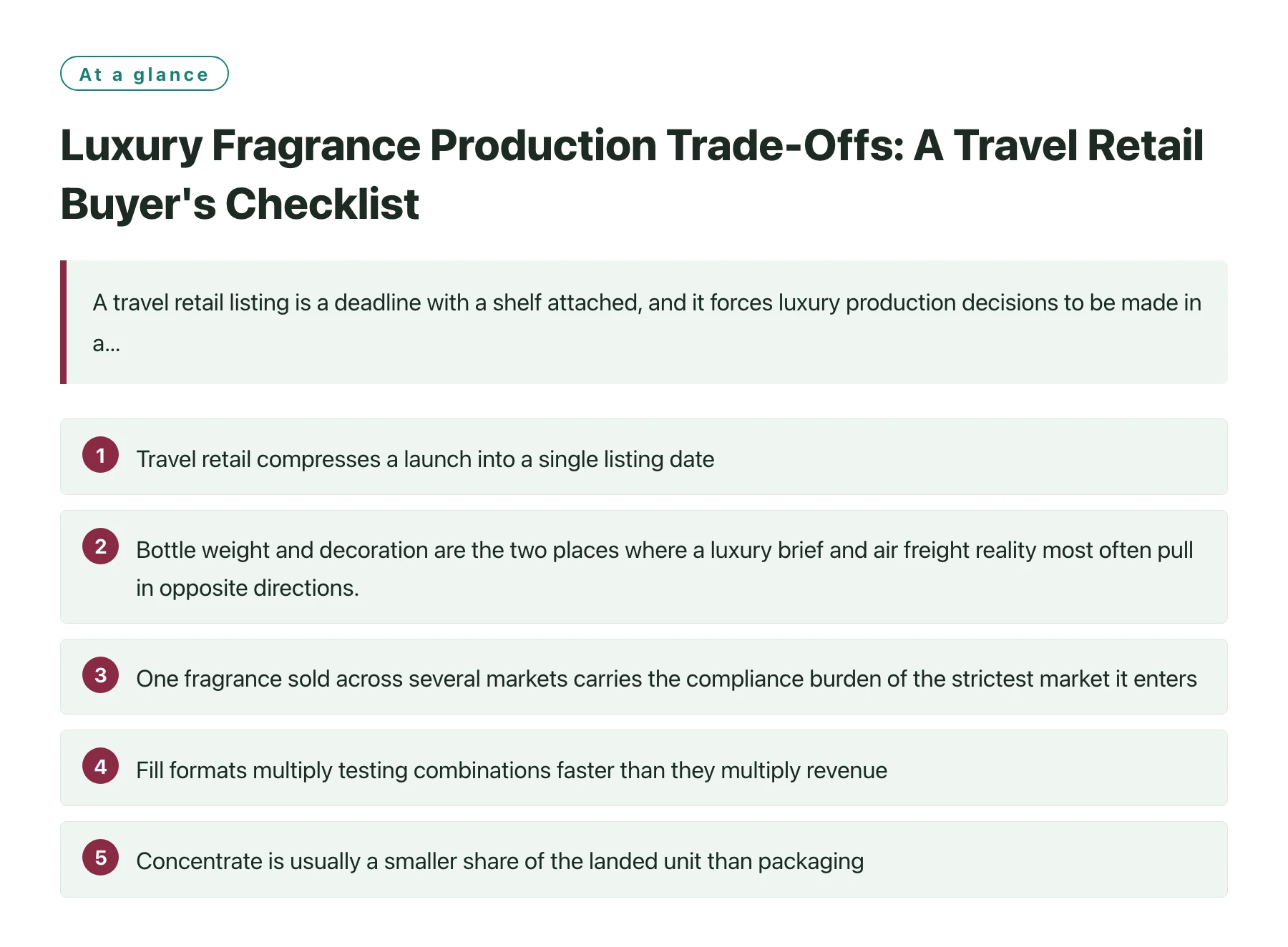
- Travel retail compresses a launch into a single listing date, so any decision that adds a testing or decoration loop is a calendar decision first and a cost decision second.
- Bottle weight and decoration are the two places where a luxury brief and air freight reality most often pull in opposite directions.
- One fragrance sold across several markets carries the compliance burden of the strictest market it enters, and EU rules alone tie safety and stability data to the product information file [1].
- Fill formats multiply testing combinations faster than they multiply revenue, so each additional SKU should be justified on its own rather than carried as a range decision.
- Concentrate is usually a smaller share of the landed unit than packaging, assembly and freight, which is why trimming the juice budget rarely rescues an over-specified bottle.
- Batch consistency rather than the approved sample is what a travel retail buyer is actually paying for, because nobody on a shop floor can adjust a scent that has drifted.
Travel retail is usually described as a channel. Operationally it behaves more like a constraint set. The product has to read at arm's length on a lit fixture, the buyer often has under a minute and no staff to explain anything, the purchase is frequently a gift, and the same unit may be offered in several countries under different labelling expectations. Those conditions push luxury production towards specific answers, and they punish solutions that were designed for a domestic counter and relabelled at the last minute.
That is why the interesting decisions in a duty free launch are not matters of taste. They are the places where two legitimate requirements cannot both have everything they want: weight against freight, decoration against calendar, format count against testing load, exclusivity against volume, resting time against the date. Each of these is cheap to resolve early and expensive to resolve late, because the late version involves a change order, a re-test or a slipped slot on the fixture plan.
This checklist walks through the trade-offs in the order a project meets them, and names what should be settled before money changes hands.
Six trade-offs a travel retail listing forces
| Trade-off | Why the channel sharpens it | What to settle before the deposit |
|---|---|---|
| Bottle weight against perceived quality | Airport retail reads heft as value, while glass cost, freight and breakage all rise with it | A target weight band with a tolerance, agreed against the shelf fixture rather than against the sample table |
| Decoration against calendar | Coating, frosting, foil and print each add a separate approval and a separate vendor slot | Which finishes are launch-critical and which can move to a second production run |
| Format count against testing load | Every fill and pack combination is its own compatibility question, and each one costs a test cycle | The SKU list, with the commercial reason for each format written down |
| Juice budget against packaging budget | Concentrate is often the smaller line on the landed cost sheet, so the cheap cut is the visible one | The ratio you are willing to accept, decided before the first packaging quote arrives |
| Exclusivity against volume | A travel exclusive competes for the same concentrate, the same line time and the same components as domestic volume | Whether the exclusive is a distinct formula or a distinct pack around a shared one |
| Resting time against the launch date | Maceration and bulk resting need calendar space that sampling rounds quietly consume | How much resting the formula needs and exactly where that window sits in the schedule |
Read as a list, these look like procurement details. Read as a sequence, they are the order in which a launch loses its date. The trade-offs that hurt most are the ones settled by default, when nobody decides and the project simply follows a supplier's own standard high-end perfume production route, which may be perfectly sound for a domestic line and wrong for a fixture with a fixed handover date.
Where the money and the calendar actually go
Owners tend to assume the scent is the expensive part of a fragrance, because it is the part they can smell. On a luxury launch the concentrate is a meaningful share of the landed unit but rarely the dominant one. Glass, decoration, pumps and caps, secondary packaging, assembly, freight and test work usually account for more, and several of those lines scale with choices that were made for aesthetic reasons and never revisited.
The calendar behaves the same way. Compounding a batch is comparatively quick. Getting a decorated bottle, an approved carton, a cleared label and a completed stability record into the same week is not, and that is where a launch date is won or lost. A useful discipline is to build the schedule backwards from the in-store date and then check that every decoration and test fits inside the remaining window.
Restricted materials set the outer boundary of what a brief can ask for. The limits that apply to a given material depend on the product category and the concentration in the finished product, and those limits are published rather than negotiated [2]. Checking a candidate against them before it is selected avoids the worst version of a late change, where the accord that defines the launch has to be rebuilt because one material cannot sit at the required level in a body product or a room spray.
Testing scope is a schedule item, not a formality
Compatibility and stability work is often quoted as a lump sum, and the lump sum is only meaningful once it names the combinations being tested. One scent in one bottle is a single question. The same scent in a travel spray, a refill and a discovery vial, each with its own closure, is several. Add a soap or a lotion to the same range and the count rises again.
The practical move is to ask which combinations are included, at what conditions, for how long, and whether the work is done in-house or commissioned from an independent laboratory. It is also worth asking what happens to the data if a component changes after testing, because a substituted pump or a reformulated lacquer can invalidate a result that was expensive to produce.
Format is a design decision with a testing bill
Travel formats exist because passengers buy small, giftable and regulation-friendly sizes. A ten millilitre spray, a refillable case and a three-piece discovery set all make commercial sense. What they do not do is share a test result. If the launch carries five formats, the project carries five sets of compatibility questions, five carton specifications and five sets of artwork approvals.
Two formats done thoroughly will usually outsell five done thinly, and the shop floor does not reward range for its own sake. Decide the format count from the passenger's likely mission, then let the production plan reflect that number rather than the other way round.
How to read a supplier's answers
The difference between a partner who has delivered travel retail and one who has not shows up in specifics. The experienced answer names the market list before it names the market, describes decoration as a sequence of vendor slots with approval points, and pushes back when a brief asks for more formats than the volume can justify. The inexperienced answer agrees with everything and adds a caveat later.
A second signal is how release criteria are described. Ask which party signs off the first bulk batch, what it is compared against, and how long the reference is retained. A supplier that can answer without consulting anyone is describing quality control in luxury fragrance production as a system rather than as a promise, and that distinction matters most in the month when the launch date is close and the fixture plan cannot move.
Three questions that expose a thin plan
First, which markets will this exact unit be offered in, and which of them requires the most on-pack information? Second, which decoration and packaging steps sit on the critical path, and what is the fallback if one of them slips? Third, if the first bulk batch does not match the approved reference, what happens to the launch date? Suppliers with a real travel retail history answer all three in concrete terms, and their answers usually include at least one thing the buyer had not thought about.
A useful test of a brief is whether it can be answered without asking a marketing question. If the answer to which markets or which formats is still to be confirmed, the production plan is not yet a plan, and every later change becomes a change order. Buyers who work through Xuelei tend to notice the same pattern: the projects that ran cleanly were the ones whose channel, market list and format count were fixed before the bottle was chosen.
Sources
- European Commission: Cosmetics in the EU —— The European Commission's overview of EU cosmetics rules, including the responsible person, product information file and safety report requirements.
- IFRA Standards Library (International Fragrance Association) —— The IFRA Standards Library lists the restrictions the fragrance industry applies to individual fragrance ingredients, based on safety assessments; it is the reference point for compliant fragrance formulation.
Frequently asked questions
How much time should stability and compatibility testing add to a travel retail launch?
It depends on the claim and the pack count rather than on the fragrance. A single format in one pack with a modest shelf-life claim needs a shorter programme than five formats across decorated glass, plastic and a pump. What matters is that the testing window is placed in the schedule before the launch date is promised, not after, and that the plan names the conditions and the duration in writing.
Should a travel exclusive use a different formula or just a different pack?
A different pack around a shared formula is usually cheaper and faster, because the concentrate, batch records and much of the test data carry over. A genuinely distinct formula is justified when the exclusive is meant to be a different scent story, but it adds a development cycle, a new set of compatibility questions and another reference to manage on every reorder.
Is it worth reducing bottle weight to cut freight?
Only against a stated weight band rather than as a general rule. Lightweighting lowers freight and glass cost, but it can also make a luxury unit feel cheap in the hand, and travel retail shoppers use weight as a proxy for value. Decide the acceptable band with the fixture and the brand position in view, then hold the supplier to it as a specification with a tolerance.
How many SKUs should a first travel retail launch carry?
Fewer than most briefs propose. Each SKU brings its own pack, artwork, test coverage and forecast, and the channel rewards a clear story over a wide shelf. A common starting point is one hero format, one giftable format and one refill or travel size, with the option to extend in a second run once sell-through data exists.
What does an airport retailer typically ask for before a listing?
Usually a product information file or its equivalent, safety and stability data, label artwork showing the required market information, certificates covering the manufacturing site, and evidence that the batch supplied matches the approved reference. The exact list varies by market and retailer, which is one more reason to fix the market list early rather than after the packaging is printed.